

Why Does a Peacock Spread Its Tail? The Dazzling Science of Feathers
Why Does a Peacock Spread Its Tail? The Dazzling Science of Feathers
Few sights in the natural world are as breathtaking as a peacock in full display — its enormous tail fanned out in a shimmering arc of blue, green, and gold. But why do peacocks do this? And how do those feathers produce such extraordinary colour? The answers involve some fascinating science — and a very discerning audience.
It's All About Impressing the Peahen
The peacock's spectacular tail — technically called a train — exists for one purpose: to attract a mate. The peahen (the female) is the one doing the choosing, and she's remarkably selective. Research has shown that peahens pay close attention to the number, symmetry, and vibrancy of the eyespots on a male's train. Males with more symmetrical, brightly coloured trains tend to be healthier and produce stronger offspring — so the peahen's preference is actually a very sensible evolutionary strategy.
Colour Without Pigment — The Magic of Structural Colour
Here's the extraordinary part: peacock feathers contain almost no blue or green pigment. The vivid colours are created entirely by the microscopic structure of the feather barbules. Tiny crystal-like structures in the feathers reflect and refract light at specific wavelengths, producing colour the same way a soap bubble or an oil slick does. This is called structural colour, and it means the feathers shimmer and change as the viewing angle changes — which is exactly what makes them so mesmerising.
The Train — An Extraordinary Feat of Biology
- A peacock's train can be up to 1.8 metres long — longer than the bird's body.
- It contains up to 200 feathers, each tipped with an iridescent eyespot.
- The train is shed and regrown every year after the breeding season.
- Despite its size, the train accounts for only about 60% of the peacock's total feather mass.
- Peacocks vibrate their feathers at a frequency that creates a rustling sound inaudible to humans but detectable by peahens.
Fascinating Peacock Facts
- "Peacock" technically refers only to the male; females are peahens, and the species as a whole is called peafowl.
- Peafowl are native to South Asia but have been kept in parks and gardens worldwide for centuries.
- They can fly, despite their size — they roost in trees at night to avoid predators.
- A group of peafowl is called a muster or a party.
- Peafowl are omnivores, eating insects, plants, small reptiles, and seeds.
- They can live for up to 20 years in the wild.
Peacock Activities for Kids
- Structural colour experiment: Hold a soap bubble or CD in sunlight and observe how the colours change with angle. Discuss how peacock feathers work the same way.
- Symmetry art: Draw a peacock tail and create a symmetrical pattern of eyespots. Discuss why symmetry signals good health.
- Feather science: Examine a feather under a magnifying glass and identify the barbules. Discuss how their structure creates colour.
- Natural selection: Discuss why peahens prefer males with more eyespots. How does this drive the evolution of the peacock's train over generations?
Bring the Farm to Life
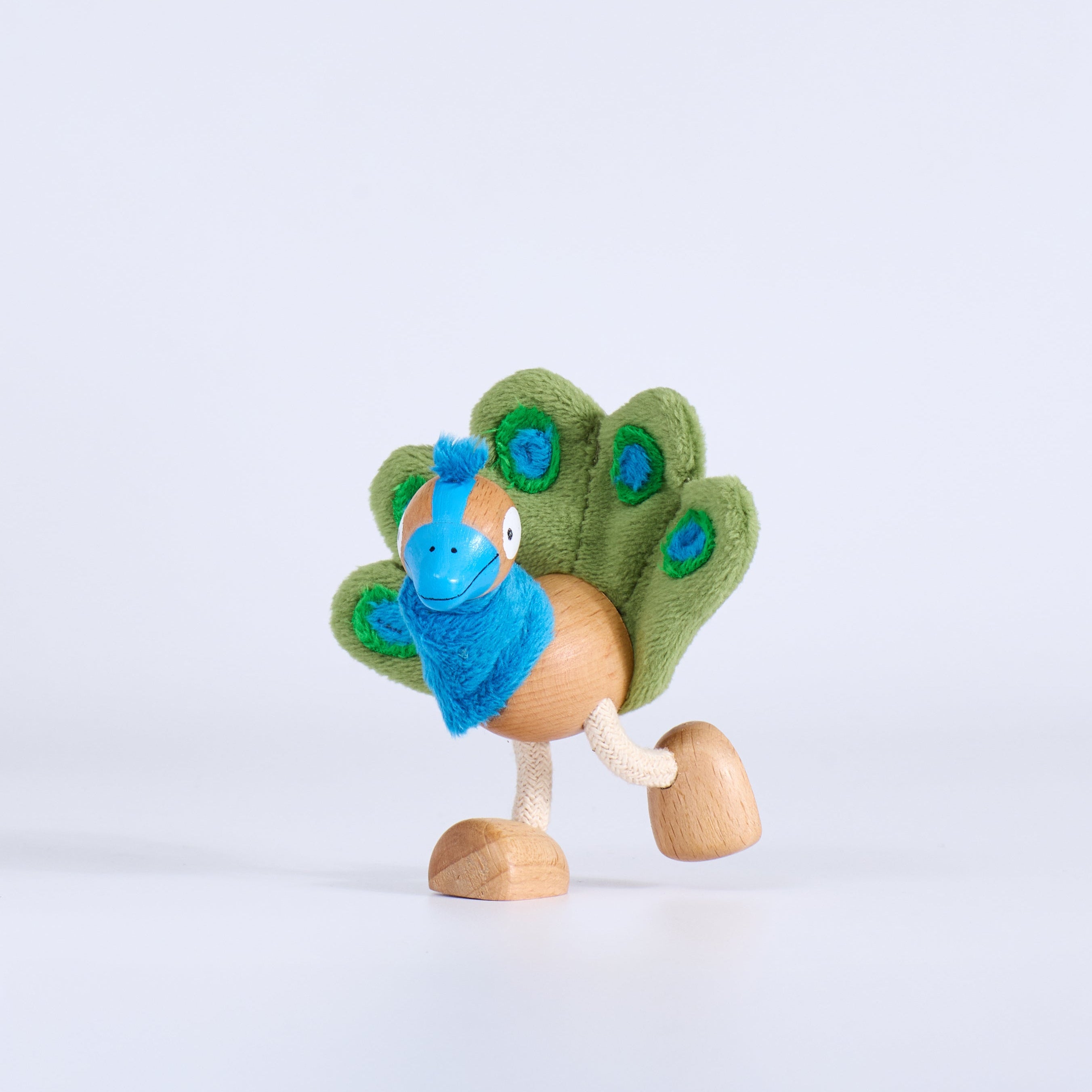
Our wooden peacock figurine is part of the Barnfields collection — beautifully crafted from sustainably sourced timber.
Shop the Barnfields Collection →
Further Reading & Resources
- National Geographic — Indian Peafowl — facts, photos, and videos about peacocks, ideal for classroom research and independent reading.
- BirdLife Australia — Australia's leading bird conservation organisation, with resources on bird biology and behaviour including structural colour in feathers.
- Natural History Museum — How Do Peacock Feathers Get Their Colour? — the London Natural History Museum explains the science of structural colour in peacock feathers in clear, accessible language.
- Science Daily — Peacock Feather Vibration Research — research on how peacocks vibrate their feathers to produce sounds that attract peahens.
- DK Find Out — Peacock — child-friendly, curriculum-aligned peacock facts perfect for primary school learners.
Explore more animal facts on our Ramblings blog.

Send us a note